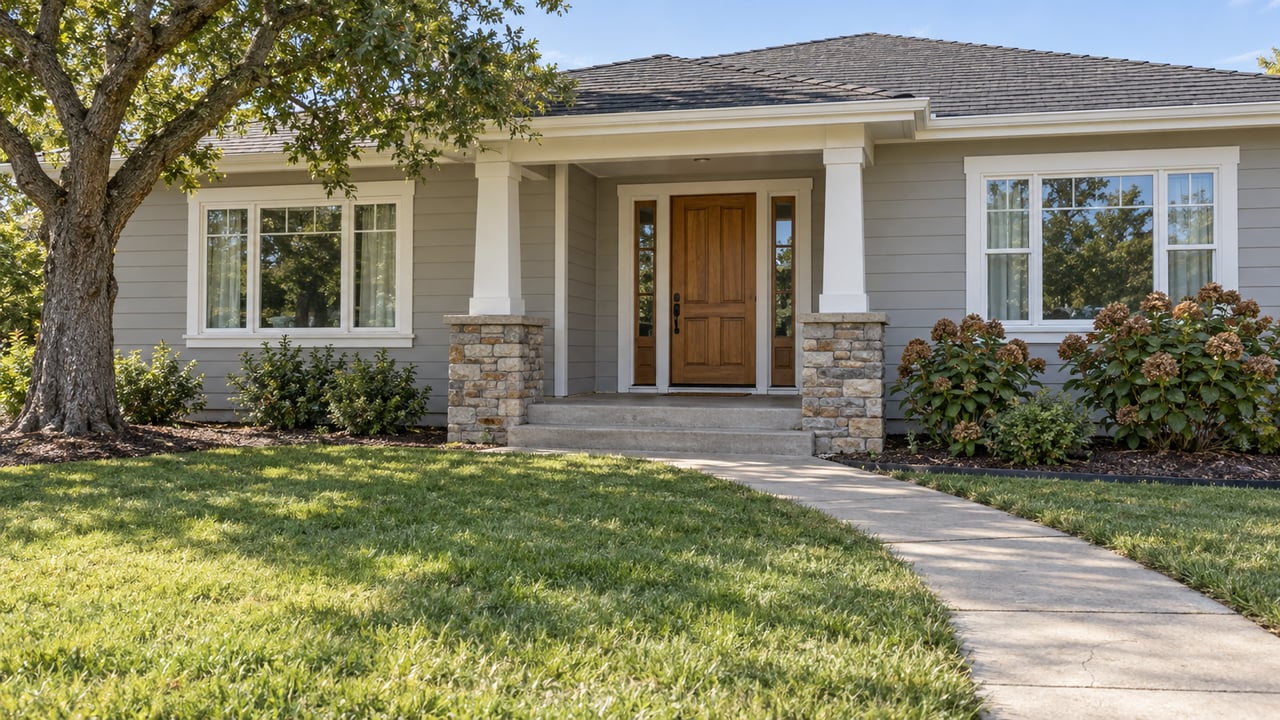
Campbell Became California's Test Lot for Starter Homes. The Rules Change Again in January.
October 22, 2026
October 22, 2026
In Campbell right now, whether a single-family lot can become a small cluster of starter homes depends mostly on one date. It's the date the developer files the application, and the question is whether the lot counted as legally "vacant" that day. Over the past eighteen months the City Council, a state housing agency, and the Legislature have each changed that date or the meaning of "vacant." The next change applies to applications received on or after January 1, 2027.
For a buyer comparing Campbell with nearby cities, that date shapes what could be built next door. For an owner thinking about selling an older home, it shapes who might bid on it.
Mercury Lane Townhomes, a six-home project at 300 Redding Road, broke ground on March 6, 2026. KQED reported that state Sen. Anna Caballero, who wrote the law, believes it is the first construction anywhere in California under SB 684, the Starter Home Revitalization Act. The law offers a fast approval path for projects of two to ten homes. Qualifying projects skip the public hearings and environmental reviews that normally come with new development. If a project meets the legal requirements, the city has to approve it within 60 days.
The developer is AlphaX RE Capital of Cupertino. According to San José Spotlight, AlphaX and its affiliated companies were behind seven of the projects the city had approved by April. Under the law, the homes in a project can average no more than 1,750 net habitable square feet. KQED reported that Mercury Lane was expected to be finished in early 2027, with starting prices projected around $1.15 million.
For comparison, the Santa Clara County Association of REALTORS September 2026 report puts Campbell's median single-family sale price at $1,910,000, across 18 closed sales. That's about $760,000 above Mercury Lane's projected starting price. That gap is the business case. In much of Campbell, an older house on a standard lot is worth one price as a home and possibly another as the site for several smaller ones.
The state law allows starter homes on lots zoned for multifamily housing, or on lots zoned single-family that are vacant. The original law never said when a lot had to be vacant. Campbell's answer to that question has changed several times:
| When | What changed | Source |
|---|---|---|
| 2025 interim ordinances | A single-family lot only had to be vacant by the final map or building permit, whichever came first | HCD letter to Campbell |
| April 21, 2026 | Interim Ordinance 26-2347 moved the test to the day the application is submitted | June 2 staff report |
| May 19, 2026 | A motion to extend that ordinance fell short of the four votes required | Same staff report |
| June 2, 2026 | Ordinance 26-2349 extended the rule 4–1, through April 20, 2027 | Council minutes |
| July 17, 2026 | The state Department of Housing and Community Development, known as HCD, wrote that a lot should be vacant at application submittal | HCD letter |
| September 29, 2026 | The governor signed SB 1116, which redefines "vacant" for applications received on or after January 1, 2027 | SB 1116 text |
The earlier rule is what drew attention. San José Spotlight described the path it allowed. A developer could buy a lot with a livable home, get preliminary approval for a multifamily project, and then demolish the house. At the April 21 meeting, residents asked the council to undo the projects already approved under that rule. The council declined. The outlet reported those projects would add 108 homes. The June vote to extend the newer, stricter rule was 4–1. Councilmembers Furtado, Scozzola, Bybee and Hines voted yes, and Councilmember Lopez voted no.
The fight over what "vacant" means covers only part of the pipeline, though. HCD's letter counted 16 starter-home applications in Campbell as of May 20, 2026, with 11 of them filed in 2026 alone. Only 8 were on single-family-zoned lots. The vacancy test never applied to the other half, which sit on multifamily-zoned land. The city keeps a running list on its Starter Home Projects page.
If a lot must be empty on the day an application is filed, the obvious workaround is to demolish the house before filing. The city asked HCD about exactly that, and HCD's July 17 letter answered.
HCD wrote that the state's Housing Crisis Act does not bar a city from issuing a standalone demolition permit for an existing home. That law's replacement requirement only applies to housing projects that include demolition as part of the application. A later project on that lot would still face two five-year lookback rules, one for whether the lot counts as vacant and one for replacing protected units.
The council had directed staff in April to study a demolition-control ordinance that would limit those permits. HCD declined to say whether Campbell could adopt one. The letter cautioned that a restrictive ordinance "may impede beneficial redevelopment of sites and housing production goals."
The same letter also settled two design questions. Campbell may enforce story limits on these projects, as long as they match the underlying zone. And under the state's eligibility test, a half-story does not count toward the 1,750-square-foot average. The story-limit answer has a short life, as the next section explains.
SB 1116 applies to applications received on or after January 1, 2027. According to an Allen Matkins legal alert from September 30, 2026, the main changes for single-family lots are these:
According to the bill text, SB 1116 also makes covenants and other deed restrictions unenforceable if they would block one of these projects, except in common interest developments such as homeowners associations. The ten-home ceiling stays in place. Brownstein's October 14 summary explains that the new 15-unit threshold decides which sites qualify, not how many homes a project can include.
Campbell's June staff report had already noted that if SB 1116 became law, the city would need to consider a revised ordinance in the second half of the year.
The local debate is less about whether Campbell needs more homes than about where they should go. Jim Sullivan, a housing developer and Campbell resident, told San José Spotlight that "starter homes work, but at certain locations such as corners." Nolan Gray of California YIMBY, a group that helped write the law, told the same outlet that the April change "will not prevent demolitions — it will only mean that demolitions result in bigger, more expensive homes, rather more, smaller, more affordable homes."
Their disagreement has a direct pricing effect. When rules let more lots qualify for several smaller homes, more developers may bid against families for older houses on standard lots. When rules let fewer lots qualify, the likely replacement for an older house is one larger single-family home.
The September 2026 county report shows Campbell single-family homes averaging 45 days on market and selling at 102% of list price, with 31 homes in inventory. In August 2026, the same report showed a $1,995,000 median and 25 average days on market.
The condo and townhome numbers need more caution. Campbell's September 2026 median for that category was $610,000, but only five homes closed. In August 2026 the median was $1,106,188, based on eight sales. With so few sales, a single closing can swing the median by hundreds of thousands of dollars. These figures say more about which units happened to sell than about any trend. For pricing new starter homes, a better comparison is the closed sales of similar-size attached homes near the same street.
For a buyer, these rules add a question that a median price can't answer: what could legally be built on the lots around this house? For a seller with an older home on a standard single-family lot, the buyer pool may include people who value the land differently than a family would. Neither question has the same answer for an application filed in December as for one filed in January.
Do Campbell's April rules still apply? Ordinance 26-2349 extends them through April 20, 2027, or until a later ordinance replaces them. Applications received on or after January 1, 2027 fall under SB 1116.
How many homes can one starter-home project include? Up to ten, both under current law and after SB 1116.
Does an HOA's governing documents still apply? SB 1116's rule against restrictive covenants excludes common interest developments.
This post is general information, not legal advice, and Alexandra's role is market valuation, not land-use counsel. If you're weighing a specific property, confirm how these rules apply with a land-use attorney or Campbell's planning staff.
If you own an older Campbell home and want to understand how a family buyer and a builder might each value it before you choose a listing strategy, Alexandra Celo Cruz can walk through recent comparable sales and the timing with you. Get a Free Home Valuation & Consultation.
Stay up to date on the latest real estate trends.
Work with Alexandra for a seamless real estate experience. She helps buyers visualize dream home potential through thoughtful enhancements and guides sellers in preparing and presenting their homes to attract maximum interest and profits. With Alexandra's expertise and creative approach, your goals are within reach.
Alexandra Celo-Cruz | CA DRE# 01482661
236 N SANTA CRUZ AVE STE 104 LOS GATOS CA 95030